
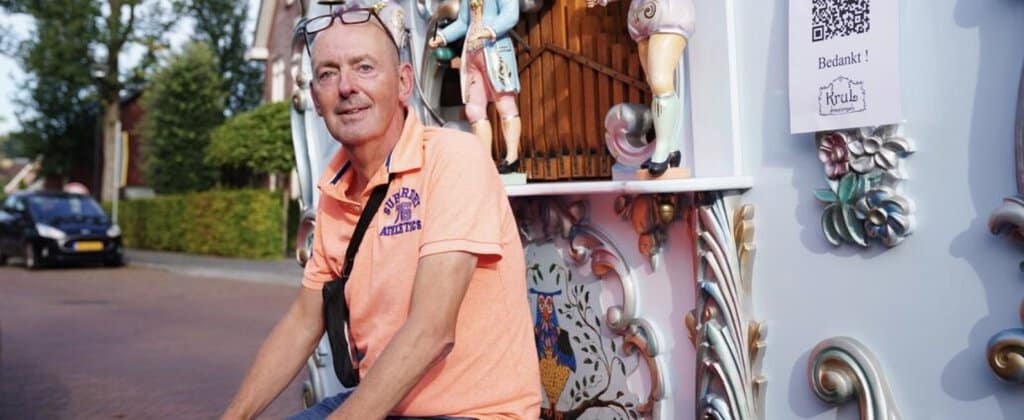
Edwin Barentsen next to the barrel organ that comes to " Bovenkerk " every week. Photo: Naomi Heidinga
“It doesn’t matter what you do, as long as you do something”
AMSTELVEEN Edwin Barentsen is active on many fronts. He’s involved in just about every activity at Bovenkerk . He’s also dedicated to helping people with Parkinson’s. The previous candidate, Ella Thierry, knows him from her time as a volunteer at Humanitas and notes that it seems as though he pulls all these activities out of thin air. She wants to ask him: How do you do that?
Friday morning, 10 a.m. on Bovenkerk. The street is quiet; everyone has already left for work or school, and the dogs have been walked. Suddenly, music fills the street. It’s a barrel organ. “Would you like to take a picture of this?” Edwin asks. “He comes by every week to play music and stops here, too.”
GLORIOUS
On November 11, 2014, Edwin was diagnosed with Parkinson’s disease. “The disease lies dormant for years before you receive a diagnosis,” he explains. He had an active career and was pursuing a master’s degree in entrepreneurship. “In this program, you learn how to develop new things and bring them to market.” He wanted to take the next step in his career. “I was faced with a choice: should I quit because of the diagnosis, or should I finish the program? In the end, I successfully completed my degree.”
HONORARY MEDAL
He benefited greatly from the knowledge he gained during his studies, especially in his volunteer work. However, the program also came in handy in the work he did for the Heilig Geestkerk and the Sint Urbanuskerk. “I worked there as a project manager after my diagnosis. The church renovation was complete, but they were still figuring out the interior design. The two congregations were merging, and each had a different way of doing things, which complicated the process. Still, we managed to pull it off.” He received a medal of honor for his work. He is still involved with the church. “I deliver greeting cards to members who are 85 or older. I do this by bike—it’s about ten trips every month. My motto is: It doesn’t matter what you do, as long as you do something.”
CHOCOLATE
That’s not the only thing he’s done for the church. After the devastating fire in 2018, he and Chris van den Helder organized all kinds of fundraising campaigns to help rebuild the church. He shows a plaque listing all the campaigns. “I had this made for Chris. I look back on that time with great pleasure. We did all sorts of things, from Christmas sales to a kids’ disco, and from the ‘golden chocolate wrapper’ campaign to fundraising events at Albert Heijn and the former Life & Garden garden center. The chocolate sale was also a huge success!” Their efforts earned them a “golden turret” award from St. Urbanus.
WALKS
He remains committed to the Parkinson’s Association and fellow patients. In the past, he contributed to patient research in various ways. “Together with others, we evaluated research for aspects such as accessibility and readability. Later, I also helped set up research projects. That led to the book *Ommetjes*, co-authored with Marina Noordegraaf, a fellow researcher. She has since passed away. The book discusses so-called ‘brain exercises’ that can help with daily functioning. For people with Parkinson’s, for example, it’s difficult to stay focused on something. There are all sorts of tricks to help with that. “If I’m typing a text message—which takes me a bit longer these days—and someone talks to me, I can’t process both at the same time. Then I have to explain that I’m finishing the message, and only then can I continue listening. So multitasking is difficult for people with Parkinson’s. You learn how to fully complete one thing with your full attention before moving on to the next.” Edwin organizes various activities for people with Parkinson’s, such as a peer support café, dance nights, singing, and sports. For example, this year there were the Parkinson’s Games at the Emergohal. “People could participate in various sports there, from archery to curling.”
SYMPTOMS
Exercise is very important for people with Parkinson’s, he says. “After exercising, your symptoms are less severe.” Parkinson’s manifests differently in everyone, by the way. Moreover, the symptoms vary from day to day. Since his diagnosis, Edwin has been struggling with stuttering. He also has more trouble finding the right words. When he gets stuck and moves his hand in a certain rhythm while speaking, the disruption clears up. He’s noticed that the disease has been affecting his autonomic nervous system lately. “For example, I sometimes experience fluctuations in body temperature, changes in blood pressure, and dizziness.” Every year, he has to decide what he can still do and what he’d be better off avoiding. “I haven’t ridden my road bike at all this summer. But I’ve replaced that with padel.” He also enjoys boxing. “Both are great sports for your core, and therefore for your coordination and balance.”
ENERGY
The disease is taking its toll, but it has also given him a lot. “I owe everything here to Parkinson’s.” He points to the table, where various awards and promotional materials for all kinds of activities are laid out. “I get energy from the things I do; I enjoy bringing people together. I can’t bear the thought of waking up to an empty schedule.” He has a large network and knows exactly who to approach for any given task. “It’s important that volunteering also benefits people—that it gives them energy. If I believe in something, I usually manage to get it off the ground. That suits me: I’m someone who gets things started. I’m not really one for consolidation; other people are better at that. Over time, I like to hand things over.” He is currently hard at work organizing a padel tournament on November 7 for people with and without Parkinson’s. Through the tournament, he hopes to raise money for research into the disease. See padelvoorparkinson.nl.
RE-ELECTION CANDIDATE
Barentsen passes the conversation on to Martine Verburg, a fellow Parkinson’s patient. He believes it’s important to focus on young people with Parkinson’s. “I have a pump for my medication, so it’s delivered continuously. That keeps me fairly stable, and I don’t have to deal with sharp spikes in mobility or drops that lead to stiffness. Martine doesn’t use a pump like that yet; she sticks to pills. I want to ask her: How do you manage without advanced medication?”
Naomi Heidinga
Source: Amstelveens Nieuwsblad