
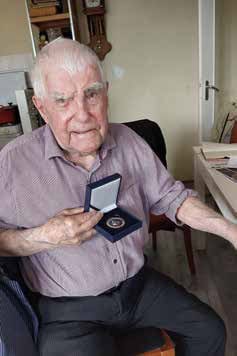
It’s already past midnight at the Noorddamcentrum. The band is playing “Radar Love” for the connoisseurs, who show no signs of stopping. At the door stands a well-known Bovenkerk resident, neatly dressed in a suit, chatting with other music lovers. Despite his age, he shows absolutely no sign of leaving. Many people know him: Cees den Haan, nearly a hundred,but still imposing, still steady on his feet. Like a king of the night.
Two days later, we’re sitting with “ Bovenkerk’s poacher” in his living room, just a stone’s throw from the Noorddamcentrum, and the first question is whether he finds that title annoying. “Why would I?” he says. “I’m a poacher, but I’ve never stolen a guilder from anyone.” And why was he a visitor to the very popular Herfstpop?
His son played the saxophone in a band for years, which explains his love for pop music. For a man who’s nearly a hundred, that’s remarkable to say the least, but how many Stones fans are already walking or shuffling around in senior living communities and nursing homes?
Indeed: he has fished, hunted, and caught game where it wasn’t allowed. A life-size photo collage featuring enormous zander and carp hangs on the wall, and in the corner of the room stands an antique double-barreled hunting shotgun. “I inherited that hunting and setting traps,” he says. “From both my father’s and my mother’s sides. One was from Zevenbergen, the other from Werkendam, and we lived as a family in Papendrecht. Poaching was a way to survive. But hunting and fishing are also in your blood. Hunters are true nature lovers. My father was a day laborer on a farm, earning about 7 guilders a week. My mother milked the cows for three kwartjes. So if you went out at night to catch hares, that was a nice bonus. Sometimes you’d catch as many as ten in a single night. Or you’d set traps. Here in the Poel, I sometimes caught as much as 35 pounds of eel. That’s right: back then, you still could. Or I’d catch rabbits with the help of a ferret.
I even had a permit for that. How did it work? If you take good care of a ferret, it’ll listen to you. You look for a rabbit burrow. You block one opening with a net. In the other, you place the ferret, which chases the rabbits toward the net. It sounds simple, but you have to be able to find your ferret again. I also caught moles in the woods. For their fur. I wasn’t the only one
who caught moles. But those were different people.’
He sees the disbelief on my face and explains: “I’ll tell you how I caught the eels
. During ‘spawning season,’ when the pike are spawning. First, you fish for pike, then collect the roe in a container. You coat the rings of the trap with roe, and the eels go wild for it. Other animals love it, too. Take the ducks, for example—they gorge themselves on roe
until it even sticks to their feathers. And that’s how they help spread the fish population, even in enclosed bodies of water. You only see things like that if you really look around you in nature, especially at the animals’ behavior.”
As a nature lover, Cees has always been surrounded by animals. How did he “farm” in his own way in various places? Cows and sheep—no, not pigs—mainly lots of sheep on a small plot near Fokkerweg, and he spent twenty years in the livestock trade. That requires a keen eye for the animals’ health, not to mention their weight. You have to be able to estimate the latter fairly accurately by eye, and Cees could do just that. Impressive for someone with only a primary school education, as it was still called back then.
He himself says, “I don’t like to brag,” especially when we’re talking about the war years, during which he was actively helping people
—much against the occupiers’ wishes. It earned him a forced stay in the detention center
Although he is short in stature, he is “no pushover.” For example, he isn’t afraid of a con artist who tried to swindle him out of money at his home two
years ago. His decisive action was highly appreciated by the police.
Cees den Haan is a true Bovenkerker through and through. You can tell right away when he talks about his colorful life story, which
is teeming with—no, overflowing with—Bovenkerk family names: Van Schip, v.d. Jagt, Braat, Voorpostel, Bloos, Veldt, Buskermolen, Celie, Bruine de Bruin, van de Meer, Pothoff, Splinter. And we’re only talking about the residents of what was then known as Noorddijkje. All of them vanished due to the so-called “Bosplan.” Almost an entire village was wiped off the map back then. And he mentions the names of streets and lanes such as Janselaan (where he used to live), Middenweg, and Luwte—which you’ll search for in vain on a map of Amstelveen today. “The whole world has changed,” he says in a philosophical tone. The world has become harsher, but fortunately, Bovenkerk has still retained some of its original village atmosphere. And what about him?
“I’ve gotten older, but I’m still reasonably healthy and active. That’s important. I don’t hunt anymore, but I’m still
crazy about game. People bring it to me now—a little rabbit or a zander. My knives are always sharp. And I know
how to butcher and debone. That’s part of hunting. I still cook everything fresh. Soon I’ll be making soup with Edwin again. And I drink my cup of coffee across the street. That’s really important!”
Cor de Horde